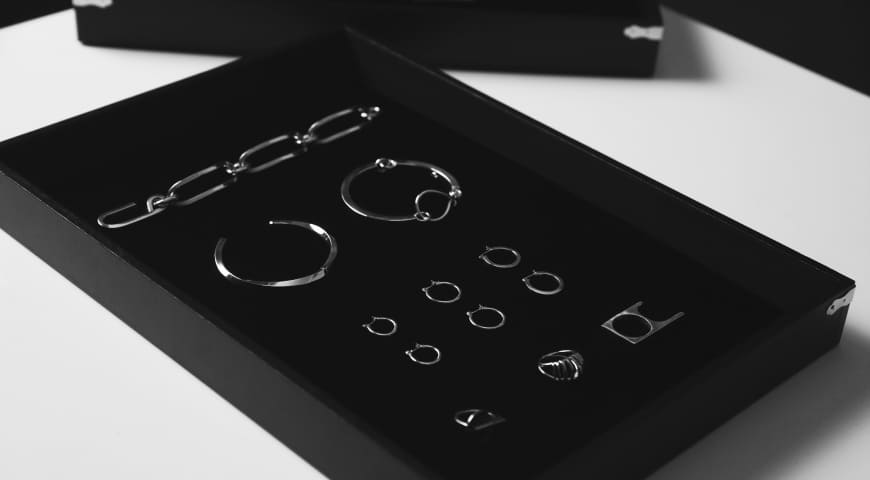
We are Nine Nine, a jewelry brand specializing in silver 925.
Silver accessories are often lumped together, but there are actually many different types.
You may have wondered why the prices of the same silver accessories vary so much.
The two materials that play a major role in the price difference are "Silver 925" and "Sterling Silver."
I would like to explain what these often-heard terms "Silver 925" and "Sterling Silver" are.
What is called silver accessories?

First of all, the term "silver accessories" generally includes
- Silver-colored alloy accessories
- Accessories made of alloy plated with 925 silver
- Accessories made of 925 silver
- Among the 925 silver, sterling silver accessories
They are divided into these four categories, with prices increasing in the order of ① to ④.
Let's take a look at the differences between these four types of silver accessories.
(Note: Regarding ① and ②, they are not considered silver jewelry in the jewelry industry, but when you look at the market, you will see them being used interchangeably, so I would like to mention them here.)
① Accessories made from silver alloy
First, there are silver accessories that have "alloy" written in the material column.
There are various materials used, but relatively inexpensive metals such as titanium, stainless steel, and white brass are commonly used.
It may be difficult to tell the difference in photos, but it is completely different from silver 925.
It rusts when exposed to water, becomes dull, or is difficult to clean if scratched, and is not very durable, so it is not suitable for long-term use.
It is sometimes called silver accessories because it is silver-colored, but you should be careful as it may contain inexpensive metals that are prone to causing metal allergies.
As a side note, titanium and stainless steel are less likely to cause allergies, but this varies from person to person, so we recommend that you check the materials used before purchasing silver accessories that do not have an engraving such as sv925 or 925.
② Accessories with 925 silver plating on alloy
Next, as the name suggests, accessories that are plated with 925 silver on top of inexpensive alloys are also called silver accessories.
The most common type is brass plated with 925 silver.
I think this is what makes silver accessories so confusing, but accessories that have been plated with 925 silver on top of this alloy can also be stamped with 925 silver.
Furthermore, in the case of silver 925 plating, there is no stamp like the GP stamp on gold plating, and when looking at online shopping sites, the material column often does not mention plating, but simply says silver 925.
To be precise, if it is silver plated, it should be stamped with AGP, but in most cases there is no stamp.
It is true that the plated parts are made of 925 silver, but the majority of the material is alloy, and the plating will peel off over time.
There is also a very high chance of developing an allergy from the cheap metals used underneath the plating.
In the past, I have had the experience of suffering from a severe metal allergy caused by jewelry that I thought was 925 silver.
There is no problem if you choose a 925 silver plated product because it is cheaper, but there are many shops that sell products in a way that makes you think they are 925 silver products without specifying the plating.
On online shopping sites and flea market sites, it is common to see items being sold as 925 silver or sterling silver at prices that would result in a complete loss if the item were not plated, given the silver market price.
Unfortunately, it is difficult to distinguish the plating of 925 silver from a photograph, and even if you see the actual item in a shop, it will be difficult to tell the difference unless you are someone who regularly deals with 925 silver.
Of course, if you put the two side by side, they shine completely differently, but I think that's not the case in most situations.
If there is a store clerk nearby, you might want to ask, "Is this 925 silver bullion?"
If the store clerk replies, "Yes! It's bare metal!", then it is definitely bare metal and not plated.
On the other hand, if you get a vague answer like "Is it the base metal?", it means that they don't know whether it's plated or made of 925 silver base metal, so you should be a little careful when purchasing from them.
③Accessories made of 925 silver
And finally, there is silver 925. To make things even more confusing, there are two more types of accessories that use silver 925 as the material.
These are the two materials: "Silver 925" and "Sterling Silver."
First, let's explain what silver 925 is.
Silver 925 refers to a silver alloy that is made of 92.5% silver with 7.5% alloy added to increase strength and durability.
Silver that contains this 7.5% alloy and metals other than copper, such as nickel or aluminum, is called 925 silver.

In principle, only items that are made from materials with the composition described above can be called (stamped) silver 925.
As mentioned in ②, please be aware that silver-plated accessories are often confused and labeled as 925 silver.
Also, many people who have experienced allergic reactions to 925 silver products are likely reacting to the alloys such as nickel and aluminum that are contained in the 7.5% silver.
However, because it contains 92.5% expensive silver, it is far less likely to cause allergies and is more durable than silver alloy or plated accessories, and it can be polished to restore its shine.
There are many silver 925 accessories on the market that are too cheap, but there is always a reason why they are cheaper than others.
Even if cheap products imported from overseas are stamped with 925, they may not be made of 925 silver in the first place, or they may be plated with 925 silver.
Please be aware that there are many cases where sellers do not know what 925 silver is and end up selling such inferior products at low prices.
④Sterling silver accessories, even among 925 silver
What is "sterling silver"? The answer is simply silver 925.
However, to be called "sterling silver," certain conditions must be met.
It is a silver alloy made of only 92.5% silver and 7.5% copper .

・Silver 925 = Silver alloy mixed with metals such as nickel and aluminum ・Sterling silver = Silver alloy made only of silver and copper
The only difference between the two is whether the alloy is only copper or a metal other than copper, so aren't they the same?
You might think so.
However, there is a crucial difference between sterling silver and silver 925: it is "age hardened."
The reason why sterling silver is distinguished from other types of silver (925) is because of this "age hardening."
"Age hardening" refers to the phenomenon in which silver and copper bond over time, causing crystals to grow and harden.
In other words, compared to 925 silver, sterling silver ages and hardens over time, becoming stronger and stronger with use.
Sterling silver is also used in silver tableware that has been used since ancient times, and with proper care it can retain its traditional shine and be passed down to the present day.
Sterling silver is a durable and precious metal that, if properly cared for, will retain its luster and last a lifetime.
Although silver is relatively affordable, its beautiful luster and durability make it a highly prized jewelry material that rivals gold.
The value of these accessories is different from that of the accessories listed in ① and ②, and naturally the price is higher than the others.
Summary of the differences between 925 silver and sterling silver

■What is Silver 925?
- A silver alloy made of 92.5% silver with 7.5% copper added to increase strength and durability. = A silver alloy made by mixing silver with metals such as nickel and aluminum.
【Features】
- Less likely to cause allergies than other alloy accessories
- Even if it gets scratched or dull, it can be restored to its original shine with care.
- It is cheaper than sterling silver
■What is sterling silver?
- A silver alloy made of 92.5% silver with 7.5% copper added to increase strength and durability = A silver alloy made only of silver and copper
【Features】
- Very unlikely to cause metal allergies
- Over time, it ages and hardens, becoming stronger.
- With proper care, it will regain its shine almost permanently and can be passed down for many years to come.
- It is attracting attention as a jewelry material that is comparable to gold.
So far, I have written about the differences between silver 925 and sterling silver, but I have also touched on things other than silver 925 accessories, including warnings.
We hope this article will help you make better accessory choices.